SPIR Seminar on Marka-e-Haq: Echoes of Courage, Lessons for Tomorrow
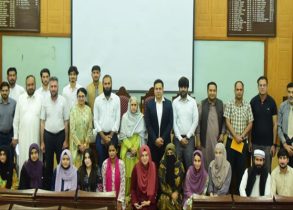
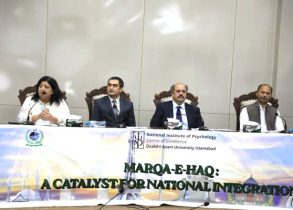
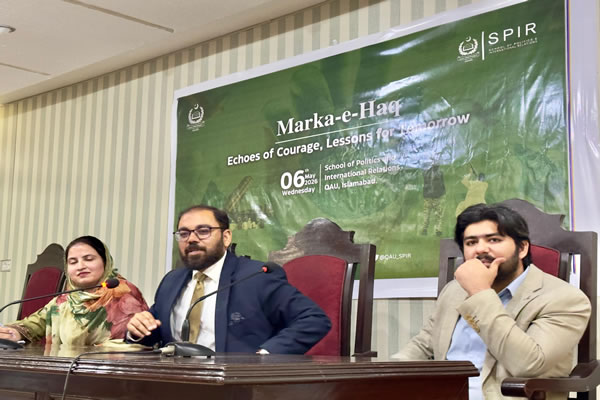
The School of Politics and International Relations (SPIR) at Quaid-i-Azam University organized a seminar titled “Marka-e-Haq: Echoes of Courage, Lessons for Tomorrow,” bringing together scholars, researchers, and students to reflect on evolving regional dynamics, strategic behavior, and lessons for the future.
The session commenced with remarks by Dr. Muhammad Mujib Afzal, who emphasized the shifting contours of International Relations. He argued that Marka e Haq has proven that power continues to shape the global order. Highlighting the rise of middle powers, he described Pakistan as an emerging actor with increasing strategic autonomy and indigenous capabilities. He noted limitations in the influence of great powers and questioned prevailing narratives, particularly regarding India’s role as a “net security provider.” Referring to Marka-e-Haq, he asserted that the episode exposed vulnerabilities within global military-industrial complexes and underscored changing power balances.
Mr Abdul Moiz Khan, Research Officer at Center for International Strategic Studies (CISS), Islamabad provided a detailed strategic analysis, framing Marka-e-Haq as Pakistan’s interpretation of recent events. He challenged the assumption that nuclear states avoid direct confrontation, describing the situation as a defensive response to Indian actions. He discussed operational miscalculations on India’s part, particularly regarding missile capabilities and early warning systems, which altered the trajectory of engagement. He further highlighted the risks posed by dual-capable weapons and the increasing role of advanced technologies, including AI, in shaping modern conflict. Emphasizing “fluid instability,” he warned that future crises may escalate rapidly under conditions of ambiguity, reduced decision time, and unresolved core disputes such as Kashmir.
Ms Misbah Arif, Visiting Senior Research Associate at the Strategic Vision Institute (SVI), framed Marka-e-Haq as a defining moment with both symbolic and strategic significance. She characterized Pakistan’s response as disciplined and calculated, asserting that it conveyed resilience and deterrence. She outlined five key realities emerging from the conflict, including Pakistan’s perceived strategic advantage, demonstrated air capability, and the diplomatic implications for India. She also identified five prevailing myths that were challenged, particularly regarding regional dominance, deterrence vulnerabilities, and the nature of restraint. She emphasized that sustainable peace in South Asia remains contingent upon resolving the Kashmir dispute, reinforcing its centrality in regional stability.
The seminar concluded with an interactive question-and-answer session, allowing participants to engage critically with the speakers. In closing remarks, Dr Sammar Iqbal babar, Director Students Affairs, QAU expressed gratitude to the speakers and attendees, reaffirming the importance of continued academic dialogue on pressing national and international issues.
The event concluded on a reflective note, encouraging deeper inquiry, informed debate, and sustained engagement with the evolving realities of global and regional politics