Seminar on “Marka-e-Haq: Rethinking Conflict and Deterrence in the Subcontinent” Held at SPIR, Quaid-i-Azam University
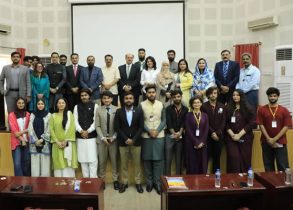
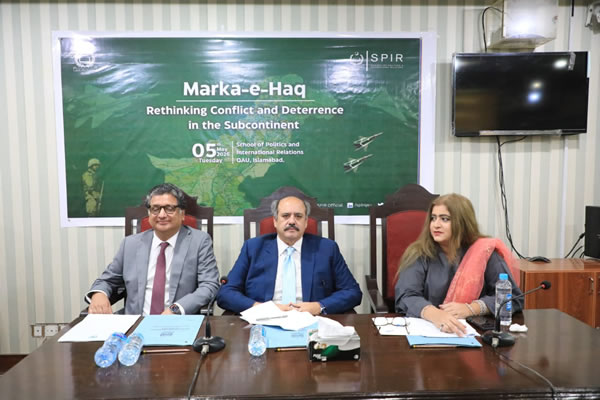
The School of Politics and International Relations (SPIR), Quaid-i-Azam University, convened an academic seminar titled “Marka-e-Haq: Rethinking Conflict and Deterrence in the Subcontinent”. Dr Muhammad Nadeem Mirza, Director SPIR welcomed the distinguished guests and noted that the events of May 2025 have changed the geopolitical configuration of the region and elevated Pakistan’s position in the international community.
Dr. Zafar Nawaz Jaspal, Meritorious Professor of International Relations and Vice Chancellor Quaid-i-Azam University, situated the May 2025 conflict within the broader theoretical frameworks of international relations, contending that the episode signified a recalibration of regional power perceptions. He argued that the conflict challenged the prevailing notion of India as an uncontested regional power, thereby reintroducing a strategic parity between India and Pakistan in international discourse. He further maintained that Pakistan’s calibrated response contributed to the restoration of a conventional balance of power, which, in turn, reinforced deterrence dynamics in the region. Notwithstanding the apparent restoration of deterrence stability, he cautioned that the absence of viable conflict resolution mechanisms continues to entrench a condition of strategic stalemate in South Asia.
Dr. Maria Sultan, President of the South Asian Strategic Stability Institute (SASSI), examined the conflict through the prism of contemporary transformations in the character of warfare. She posited that the May 2025 episode constituted a paradigmatic case in which strategic outcomes were substantially shaped during the pre-kinetic phase, without extensive land mobilization. She identified three principal determinants of Pakistan’s operational effectiveness: the strategic employment of information warfare, the real-time construction and dissemination of narratives, and the technical validation of outcomes through battle damage assessments. Dr. Sultan further highlighted the increasing salience of multi-domain warfare, wherein cyber capabilities, electronic warfare, and strategic communications operate in conjunction with conventional military means. She also drew attention to the role of both indigenous and externally sourced technological platforms in enhancing operational efficacy. Conceptually, she advanced the argument that contemporary warfare must be understood as a continuous and evolving process rather than a discrete event, necessitating the translation of military gains into diplomatic, economic, and informational leverage.
Ambassador Zaheer Aslam Janjua, former Ambassador of Pakistan to Russia and Belarus and an expert in strategic policy formulation, analyzed the conflict from the perspective of nuclear deterrence and strategic stability. He characterized the crisis as a significant stress test for the existing deterrence architecture in South Asia, revealing underlying vulnerabilities and escalatory risks. In particular, he underscored concerns regarding doctrinal ambiguity, including shifts in India’s declaratory posture on the “No First Use” principle and the employment of systems with potential nuclear capability. Ambassador Janjua argued that Pakistan’s policy of Full Spectrum Deterrence has effectively constrained the prospects of limited war under the nuclear threshold. He further emphasized the growing relevance of emerging technologies—such as artificial intelligence and unmanned systems—in shaping future conflict dynamics, while advocating for enhanced crisis management mechanisms, doctrinal clarity, and responsible statecraft to mitigate escalation risks.
The seminar concluded that while the May 2025 conflict may have reinforced certain aspects of deterrence stability, it did not address the underlying structural tensions that continue to define India–Pakistan relations. The speakers collectively underscored that South Asia remains characterized by a fragile strategic equilibrium, wherein long-term stability will depend upon sustained strategic adaptation, credible communication, and the institutionalization of effective conflict management and resolution mechanisms.